Santosh Kumar Radha
Physicist. Builder. CTO and Co-Founder at agentfield.ai
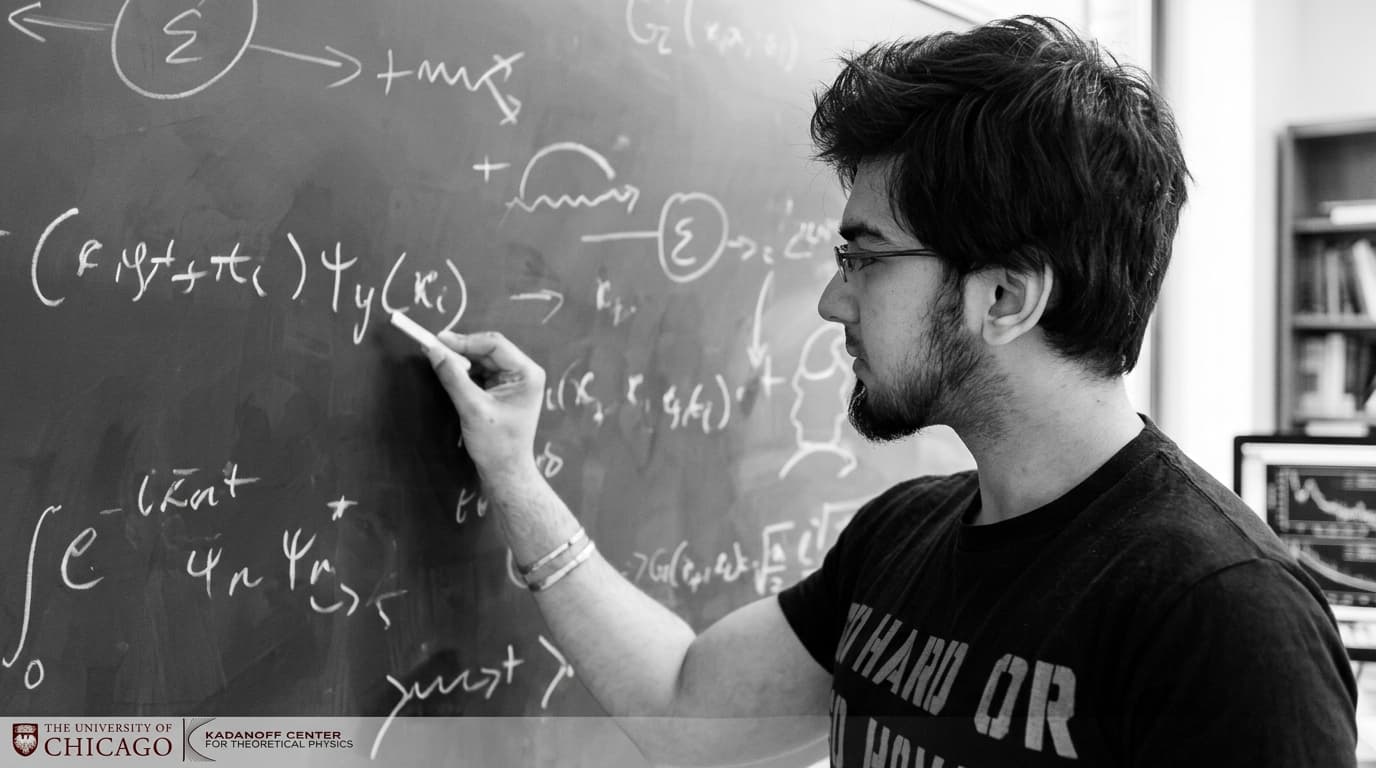
I started in theoretical physics, condensed matter theory, topology, band structures, and somewhere along the way became the person building the infrastructure underneath it all. Today I co-found and lead engineering at agentfield.ai, where we're working on identity and orchestration for AI agents. Before that I built Covalent at Agnostiq, which began in quantum computing and algorithms before evolving into an open-source platform for HPC, GPU, and cross-cloud distributed compute orchestration (acquired by DataRobot). I'm drawn to the places where mathematics, music, and algorithms intersect. When I'm not writing code, I play the mridangam, study Carnatic music, and powerlift.
Writing
Thoughts on AI infrastructure, agent systems, and physics
Subscribe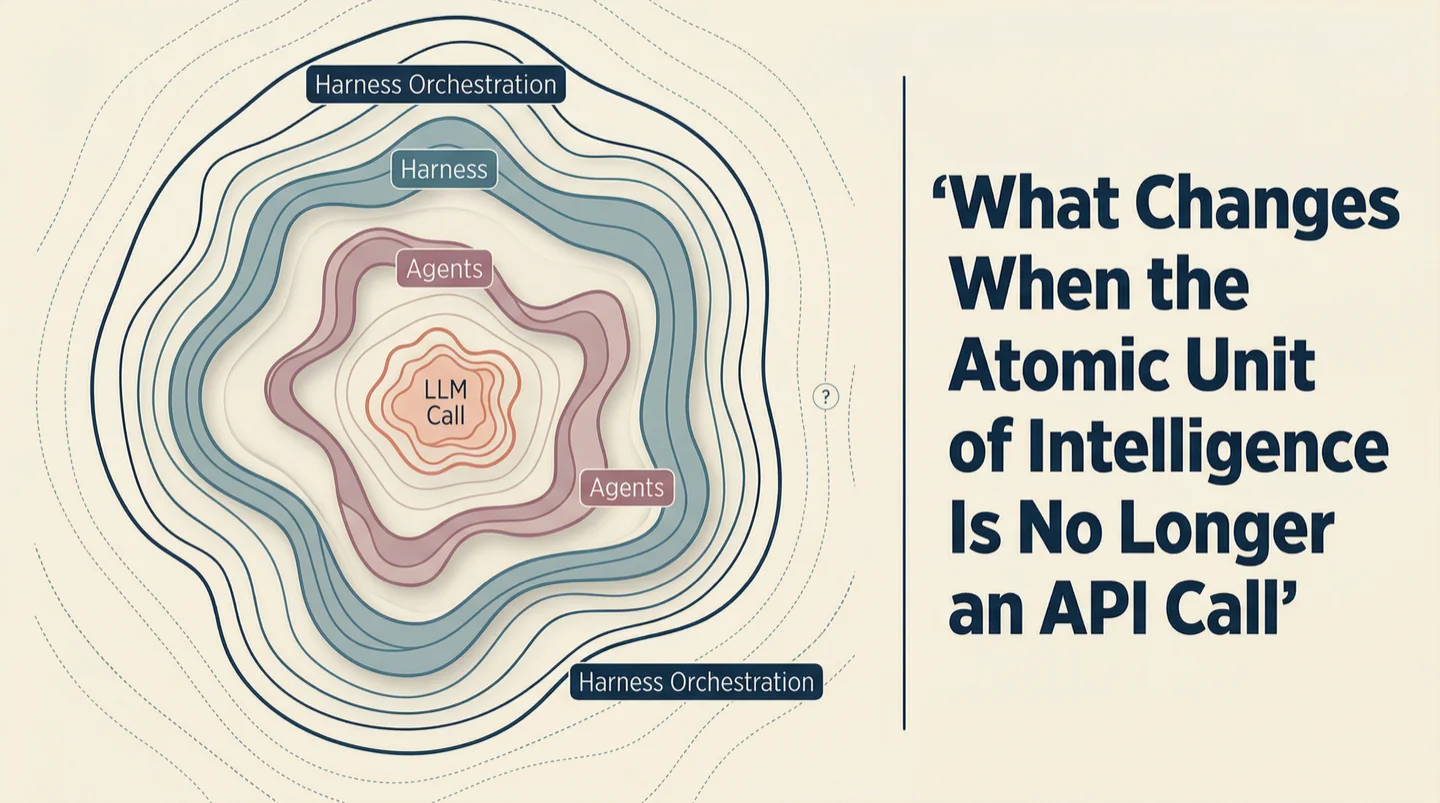
What Changes When the Atomic Unit of Intelligence Is No Longer a Single LLM Call?
March 2026 · 12 min read
How the shift from orchestrating model calls to orchestrating autonomous harnesses changes everything built above it.
When AI absorbed the execution layer, the remaining work changed shape entirely. The human contribution moved from producing the output to defining the space within which the output must live.
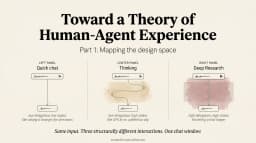
Human-Computer Interaction has had four decades of formal study. Human-Agent Experience has had none. This is an attempt to build the missing design theory: three structural dimensions, eight regions, and a map of the space that every AI product inhabits.

Our engineers use Claude Code as a daily collaborator. We wanted dozens of instances coordinating in parallel on a shared codebase. Here is what we learned after 200+ agent invocations, $116 builds, and three nested control loops.
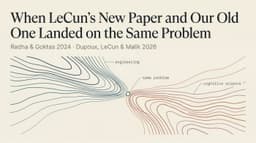
In October 2024, we published Composite Learning Units. In March 2026, Dupoux, LeCun, and Malik published a cognitive-science-grounded architecture for autonomous learning. The two papers converge on the same structural diagnosis.
The most profitable machine ever designed is the slot machine. I never expected to recognize the same pattern in my own work sessions at 2am, fully aware of what was happening.
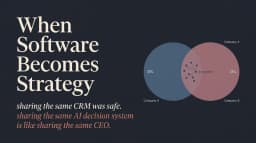
The build-versus-buy question is back. This time the answer changed because intelligence moved.
As intelligence becomes abundant, coordination becomes the limiting factor, one that can be designed intentionally or left to emerge on its own.
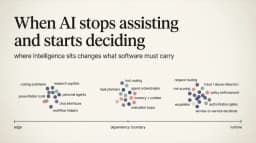
We are grouping very different kinds of systems under a single mental model. Once you look at AI through the lens of where intelligence sits in the architecture, a clearer split begins to appear.
Monoliths became microservices, and what followed was a decade of cloud native infrastructure closing gaps. Now reasoning has moved inside the backend, and every solution we built rests on an assumption it violates.
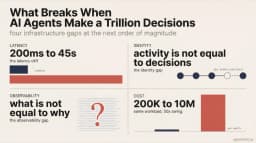
An agent approved 50,000 micro-loans in three minutes, and every individual decision passed muster. But the portfolio that emerged was toxic.
A returns agent approved a $12,000 refund it shouldn't have, and the strange thing was that nothing looked wrong. This is becoming the new failure mode for AI systems.
When software reasons, trust becomes a problem. If you can't answer 'who did this, and were they authorized?' then you don't have guided autonomy. You have unaccountable autonomy.
Five years from now, every serious software company will have an AI backend. Not a chatbot. Not a copilot. A reasoning layer that sits alongside their services.
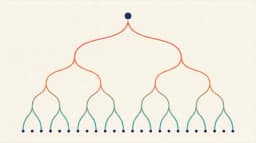
For thirty years, we built a web for human eyeballs. That era is over. As autonomous agents become our digital proxies, the most valuable parts of the internet will become an engine of pure function.
A quick and dirty implementation of binary addition using quantum circuits in Qiskit, demonstrating quantum arithmetic with carry propagation.
A tribute to my PhD advisor Walter R.L. Lambrecht, reflecting on years of collaborative research and learning at Case Western Reserve University.
Talk abstract on topological phase transitions in 2D honeycomb Group-V systems, from nodal line semimetals through Dirac cone annihilation to higher-order topological insulators.
Using Julia to model halide perovskite structures as pseudo-spin systems with Monte Carlo methods, exploring ferroelectric transitions and crystal stability.
Proposing a topological quantum switch in antimonene using electric field to break inversion symmetry, creating controllable 1D conducting channels.
Continuation of the Julia Monte Carlo project: corrected periodic boundary conditions and added dipole-dipole interaction calculations for perovskite pseudo-spin systems.
Understanding the Bogoliubov-de Gennes formalism through a simple 2-site superconductor, exploring particle-antiparticle symmetry and parity phase transitions.
Starting from the Poincare group and building toward quantum mechanics from relativistic field theory. First in a series on QFT from a condensed matter perspective.
Using the Ising model from condensed matter physics to understand crowd mentality in stock markets, with Numba optimization for blazing fast Monte Carlo simulations.
Introduction to calculating Heisenberg interaction J_ij for spin Hamiltonians using perturbation theory and transverse spin susceptibilities.
Optimizing the pySKTB tight-binding package using Numba and line_profiler, achieving an order of magnitude speedup for quantum calculations.
Open Source
Research
View on Google Scholar →AI and Reasoning
T. Pandey, A. Ghukasyan, O. Goktas, S. K. Radha
arXiv preprint, 2025
S. K. Radha, O. Goktas
arXiv preprint, 2025
S. K. Radha, O. Goktas
arXiv preprint, 2024
S. K. Radha, Y. Nouri Jelyani, A. Ghukasyan, O. Goktas
arXiv preprint, 2024
Quantum Computing
J. Baker, G. Park, K. Yu, A. Ghukasyan, O. Goktas, S. K. Radha
Quantum Machine Intelligence, 2023
A. Ghukasyan, J. Baker, O. Goktas, J. Carrasquilla, S. K. Radha
arXiv preprint, 2023
A. Hughes, J. Baker, S. K. Radha
arXiv preprint, 2023
J. Baker, H. Horowitz, S. K. Radha, S. Fernandes, C. Jones, N. Noorani, V. Skavysh, P. Lamontagne, B. Sanders
Proceedings of the AAAI Symposium Series, 2022
J. Baker, S. K. Radha
arXiv preprint, 2022
H. Horowitz, P. S. B. Rao, S. K. Radha
arXiv preprint, 2022
S. K. Radha
arXiv preprint, 2021
Journey
Co-founded; building open-source identity and orchestration for AI agents
Agnostiq
Built Covalent, starting in quantum computing and algorithms, evolving into open-source HPC, GPU, and cross-cloud distributed compute orchestration. Acquired by DataRobot.
Case Western Reserve University / Johns Hopkins University
PhD in Theoretical Physics, splitting time between both institutions
NIT Trichy
B.Tech, Industrial Engineering